

 Filtered Water Fountain
 Cozy Cocoon Calming Bed
 Personalised No-Pull Harness
 Window Hammock Perch









Do Cats Need a Water Fountain? Benefits, Hydration Tips & How to Choose
 The Whisker's & Paws team
4 min read

- A cat needs about 4 oz of water per 5 lb of lean body weight per day, roughly a cup for a 10 lb cat (Cornell).
- Wet food can be up to 80% water, so dry-fed cats need to drink more.
- Fountains are one of several proven ways to encourage drinking, but cats vary in how much they like them.
- Clean the fountain weekly and change the filter on schedule, or it stops being an upgrade.
Cats are famously casual drinkers. Many sip a little, walk away, and seem to get by. But hydration matters for every cat, and especially for cats eating mostly dry food. So does your cat really need a water fountain, or is a bowl fine? Here's what the vets say, and how to choose well if you decide to try one.
How much water does a cat need?
The Cornell Feline Health Center puts it at about 4 ounces of water per 5 pounds of lean body weight per day (Cornell Feline Health Center). That is about one cup for a typical 10-pound cat, counting the water in their food.
| Lean body weight | Approx. daily water (food + drinking) |
|---|---|
| 5 lb (2.3 kg) | 4 oz (about 120 ml) |
| 10 lb (4.5 kg) | 8 oz (about 240 ml) |
| 15 lb (6.8 kg) | 12 oz (about 355 ml) |
That figure includes moisture from food. Wet food can be up to 80% water, so a cat on wet food may drink very little from the bowl and still be well hydrated. A cat on dry kibble has to get most of that water by drinking.
Signs your cat may not be drinking enough
Cornell lists the signs of dehydration as lethargy, weakness and poor appetite, along with dry or tacky gums and skin that is slow to spring back when gently lifted over the shoulders. Severe cases can cause sunken eyes. Note that older cats can have less elastic skin even when well hydrated, so the skin test alone isn't conclusive.
Do water fountains actually help?
A fountain is on Cornell's list of ways to encourage drinking, with the honest caveat that cats vary in how much they like them. In our experience the fans tend to be cats who already prefer the tap or the shower floor, the ones who ignore a still bowl but run for a dripping faucet.
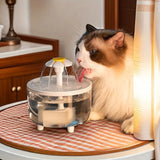
The appeal of a filtered water fountain comes down to three things:
- Movement and sound that draw a cat's attention to the water.
- Filtration that catches hair and debris, so the water stays fresher between refills.
- Capacity, so water stays available if you're out all day or have more than one pet.
Other ways to get more water into your cat
A fountain works best as part of a plan. Cornell's suggestions are simple:
- Put fresh water in several easy-to-reach places, not just next to the food.
- Prevent pet conflicts. In multi-pet homes, a cat may avoid a bowl another animal guards.
- Feed wet food or add water to meals.
- Flavour the water with a little tuna water or low-sodium chicken broth.
Pairing hydration with slower meals helps too. A ceramic slow feeder with a splash of water added turns dinner into extra hydration, and a Wi-Fi smart feeder keeps meal times consistent when you're not home.
Water fountain vs water bowl
| Bowl | Fountain | |
|---|---|---|
| Cost | Very low | Higher, plus filters |
| Water freshness | Needs refilling daily | Filtered and circulating |
| Appeal to picky drinkers | Still water only | Movement and sound draw some cats in |
| Cleaning | Quick wash | Weekly strip-down including the pump |
| Power | None | Needs a socket or battery |
Many households use both: a fountain as the main water station, plus a bowl or two in other rooms.
How to choose a cat water fountain
| Feature | Why it matters |
|---|---|
| Quiet pump | Noise-sensitive cats will avoid a buzzing fountain. |
| Replaceable filter | Keeps hair and debris out. Change it on the manufacturer's schedule. |
| Easy to take apart | If you can't clean the pump and tubing easily, you won't. |
| Capacity | Bigger tanks suit multi-pet homes and long days out. |
| Low-water protection | Prevents the pump running dry. |
| Stable base | Stops curious paws from tipping it. |
How to clean a cat water fountain
A dirty fountain is worse than a clean bowl. Slime (biofilm) builds up in the reservoir, pump and tubing, and cats will notice before you do.
- Unplug the fountain and empty it.
- Take it apart, including the pump cover. Rinse the filter separately.
- Wash every part in warm water with a mild, unscented detergent. Use a small brush on the pump and spout.
- Rinse thoroughly so no soap taste is left behind.
- Replace the filter on the schedule in the manual, sooner if it looks clogged.
- Refill with fresh water and check the pump runs smoothly before you walk away.
Top up between cleans so the pump never runs dry.
Do dogs benefit from water fountains too?
Yes, many dogs happily drink from a fountain, and a large-capacity model suits homes with both cats and dogs. Choose a size that matches your biggest drinker, and place it where a bouncy dog won't knock it over.
Setting it up so your cat actually uses it
- Keep the old bowl out for the first week or two while your cat gets curious.
- Choose a quiet spot away from the litter box and busy doorways.
- Clean weekly, including the pump, and replace filters on schedule.
- Be patient. Some cats take to it on day one, others need a few days.
Shop the filtered water fountain, explore our feeding collection, or browse everything for cats.
Frequently asked questions
Cornell Feline Health Center guidance is about 4 ounces of water per 5 pounds of lean body weight per day, so roughly a cup for a 10-pound cat. Cats on wet food drink less from the bowl because their food can be up to 80% water.
Cornell lists a water fountain as one way to encourage drinking, while noting that cats vary in how much they like them. It is a helpful tool, not a requirement, alongside fresh water in easy-to-reach places and wet food.
Rinse and refill it regularly, deep-clean it weekly, and replace the filter on the schedule in the manual. Biofilm builds up quickly in the pump and tubing.
Lethargy, weakness, poor appetite, dry or tacky gums, and skin that is slow to spring back. Severe cases can cause sunken eyes. Contact your vet promptly if you suspect dehydration.
Somewhere quiet and easy to reach, away from the litter box and ideally a little away from the food bowl. In multi-pet homes, offer more than one water spot so no cat is blocked from drinking.
Everything mentioned here.

 Best seller


